Chicken – Our Little Dinosaur
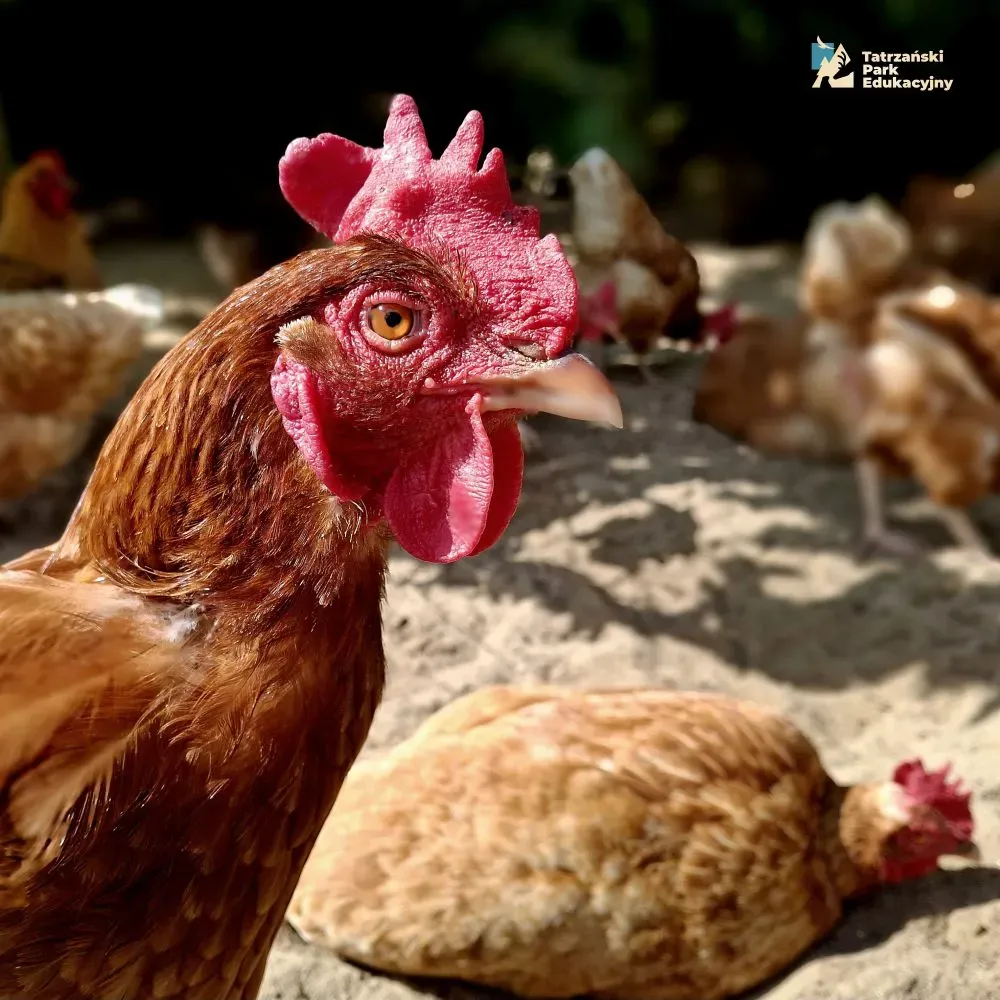
At the Tatra Educational Park, we are home to DOMESTIC CHICKENS.
Someone might say, “Pfft! A chicken!
So ordinary!”
But chickens are anything but ordinary. They have plenty of hidden talents, a rich history and some very interesting ancestors. Add to that their symbolic and therapeutic significance, and suddenly the humble chicken appears in a completely different light. Oh, and let’s not forget the chicken as a provider — it may not lay golden eggs, but it certainly lays healthy ones.
So let’s begin with some of its underrated talents.
The first is flying. A chicken may not be the most impressive flier, because its body shape and weight limit its abilities, but still… a chicken can fly. It can rise several metres into the air, which is an important skill, especially in moments of danger. If a human could suddenly lift themselves a few metres off the ground, we would definitely call that a superpower.
Chickens also have remarkable eyesight. They can perceive more colours than we can, spot predators approaching from both the ground and the air, and notice even the tiniest details. Their powers of observation could easily be called legendary, so even the smallest grain of wheat has little chance of escaping their attention.
Another ability sounds like something straight out of an episode of The Penguins of Madagascar — chickens are clever little mathematicians. It has been established that they can count… up to five. They probably will not make it into the U.S. Congress, but they are quite good at predicting the path of moving objects — which means they are capable of logical thinking.
A chicken is also quite a “linguist”. It can communicate with other chickens using dozens of different sounds. It makes you wonder what chickens talk about when humans are not listening. They are probably gossiping about us and laughing at our clumsiness, our size and our love of… scrambled eggs.
The final talent we will look at is the almost circus-like ability of these remarkable domestic birds. Chickens can learn many tricks. They are intelligent and, with the right approach and training, can avoid obstacles, jump over them and even retrieve objects. They are also known for remembering faces — it is believed that they can recognise around 100 individuals. So next time you notice a chicken staring at you, remember that it may remember you too — so behave yourself.
But the CHICKEN is not only about talent. It also carries rich symbolism.
First and foremost, the hen is often seen as a guardian of the home. This is partly due to her strong maternal instinct and partly because she can help feed an entire family. The phrase “the hen that lays golden eggs” is not merely wishful thinking or a reference to Aesop’s famous fable. It also reflects the awareness that in the past, chickens could save families from hunger and bring something truly precious into the household — health and survival.
Staying with the theme of care and protection, the hen should also be mentioned as a symbol of prosperity and fertility. All these meanings are closely connected and reveal the image of a bird that may fly low, but certainly aims high.
Maternal care, tenderness, prosperity, health, fertility, safety, happiness and harmony — all of this has made the chicken a symbol of positive values. As a character in fairy tales, folk tales and stories, it also tends to appear in a surprisingly favourable light.
With one small exception…
In old folk beliefs, a hen that crowed like a rooster, behaved unusually or drew too much attention to itself could be seen as a bad omen. To protect the household from misfortune, people believed that such a bird should be eaten quickly. But don’t worry — those days are long gone, and today hens can crow like roosters without fear.
Although if you ever come across a hut standing on chicken legs in the middle of a forest… it may still be a good idea to quietly step away.
Now we come to perhaps the most fascinating part of our chicken story — its ancestors: dinosaurs.
As it turns out, a chicken does not merely resemble dinosaurs. Modern birds are descendants of theropod dinosaurs, which means that in evolutionary terms, chickens are living dinosaurs.
Even more fascinating is their evolutionary relationship with tyrannosaurs, including the famous T. rex.
This often underestimated representative of the dinosaur world can surprise us at every turn. Its feathers, scales on the legs and characteristic way of moving all point back to prehistoric times, when much larger feathered creatures walked the Earth.
Finally, imagine a chicken standing as tall as your waist and ask yourself one question:
Would you still be able to dismiss it by saying,
“Pfft! A chicken! So ordinary!”?